Atomic Structure and Properties
Learn the fundamental structure of atoms, elements, and isotopes and understand how atomic properties influence chemical behavior.
Topics
Moles and Molar Mass
Learn how chemists use the mole to connect particles, mass, and chemical quantities.
Mass Spectrometry
Understand how mass spectrometry can be used to analyze isotopes and determine atomic masses.
Atomic Structure
Explore protons, neutrons, electrons, isotopes, and the structure of the atom.
Moles and Molar Mass
The mole is one of the most fundamental units used in chemistry to describe the amount of a substance. It connects the microscopic world of particles to measurable quantities like mass.
What Is a Mole?
A mole is a counting unit, much like a dozen. While one dozen represents 12 objects, one mole represents 6.022 × 10²³ particles.
Representative particles may be atoms, molecules, ions, or formula units, depending on the substance and the context.
Converting Between Moles and Particles
To convert from moles to particles, multiply by Avogadro’s number. To convert from particles to moles, divide by Avogadro’s number.
Example: Moles to Particles
How many molecules are present in 2.00 moles of H2O?
What Is Molar Mass?
Molar mass is the mass of one mole of a substance. It is measured in grams per mole (g/mol). The molar mass of an element is the same as its atomic mass on the periodic table.
Example: Finding Molar Mass
Calculate the molar mass of H2O.
Converting Between Grams and Moles
Molar mass is used as a conversion factor between grams and moles. To convert grams to moles, divide by the molar mass. To convert moles to grams, multiply by the molar mass.
Example: Grams to Moles
How many moles are present in 36.04 grams of H2O?
The molar mass of H2O is 18.02 g/mol.
Practice Questions
Try each problem before opening the solution.
Question 1
How many molecules are present in 0.500 mol of CO2?
Show solution
Multiply the number of moles by Avogadro’s number:
Question 2
How many moles are present in 44.01 g of CO2?
Show solution
The molar mass of CO2 is 44.01 g/mol.
Question 3
What mass of Na contains 3.011 × 10²³ atoms?
Show solution
First, convert atoms to moles:
Next, multiply by the molar mass of sodium:
Watch: Moles and Molar Mass
Watch a worked example explaining how to convert between moles, particles, and mass.
Mass Spectrometry
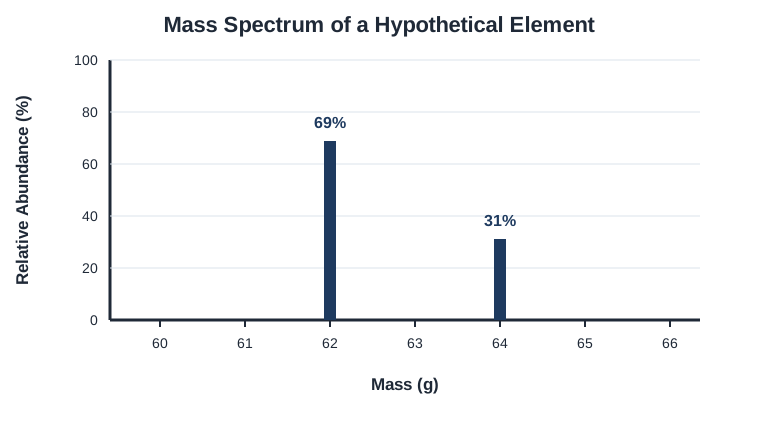
Mass spectrometry is an experimental technique used to identify the isotopes of an element and measure their relative abundances. (Remember an isotope is the same element, with the same number of protons, but with a different number of neutrons in the nucleus) The resulting data can be displayed in a mass spectrum.
Reading a Mass Spectrum
Each vertical peak in a mass spectrum represents an isotope detected in the sample. The position and height of each peak provide different information about that isotope.
- The horizontal axis shows mass of the isotope in grams (g)
- The vertical axis shows the relative abundance of each isotope.
- A taller peak represents an isotope that is more abundant in the sample.
Calculating Average Atomic Mass
The atomic mass shown on the periodic table is a weighted average of an element’s naturally occurring isotopes. This means that an isotope with a greater abundance will have a greater effect on an element’s average atomic mass.
Steps for Finding Average Atomic Mass
- Convert each percentage abundance into a decimal by dividing it by 100.
- Multiply the mass of each isotope by its decimal abundance.
- Add the results for all the isotopes.
Example: Finding Average Atomic Mass
A hypothetical element has two naturally occurring isotopes:
- An isotope with a mass of 62 amu and an abundance of 69.0%
- An isotope with a mass of 64 amu and an abundance of 31.0%
First, convert the percentage abundances into decimals:
31.0% ÷ 100 = 0.310
Next, multiply each isotopic mass by its decimal abundance:
64 amu × 0.310 = 19.84 amu
Finally, add the two contributions:
The average atomic mass is 62.62 amu. This value is closer to 62 amu than to 64 amu because the isotope with a mass of 62 amu is more abundant.
Mass Spectrometry Practice
Use the mass spectrum and average atomic mass concepts from this lesson to answer the following questions.
Question 1: Interpreting a Spectrum
A mass spectrum contains a peak at an isotopic mass of 48 amu with a relative abundance of 74% and another peak at 50 amu with a relative abundance of 26%.
Which isotope is more abundant, and what evidence from the spectrum supports your answer?
Show solution
The isotope with a mass of 48 amu is more abundant.
Its peak represents 74% of the sample, while the peak for the 50 amu isotope represents only 26%. Therefore, the peak at 48 amu would be taller.
Question 2: Calculating Average Atomic Mass
A hypothetical element has two naturally occurring isotopes:
- 70 amu with an abundance of 65.0%
- 72 amu with an abundance of 35.0%
Calculate the average atomic mass of the element.
Show solution
First, convert the percentages to decimals:
35.0% ÷ 100 = 0.350
Multiply each isotopic mass by its decimal abundance:
72 amu × 0.350 = 25.20 amu
Add the two contributions:
The element’s average atomic mass is 70.70 amu.
Question 3: Reasoning from an Average
A hypothetical element has two isotopes with masses of 24 amu and 26 amu. Its average atomic mass is 25.6 amu.
Without calculating exact abundances, which isotope must be more abundant? Explain your reasoning.
Show solution
The isotope with a mass of 26 amu must be more abundant.
The average atomic mass of 25.6 amu is much closer to 26 amu than to 24 amu. A weighted average is pulled toward the isotope with the greater abundance.
Watch: Mass Spectrometry
Watch a worked example explaining mass spectrometry and how to interpret a mass spectrum graph
Atomic Structure
Every atom contains protons, neutrons, and electrons. The number and arrangement of each of these particles varies on an atom’s identity, mass, charge, and chemical behavior.
Subatomic Particles
| Particle | Charge | Approximate Mass | Location |
|---|---|---|---|
| Proton | +1 | 1 amu | Nucleus |
| Neutron | 0 | 1 amu | Nucleus |
| Electron | −1 | Approximately 0 amu | Outside the nucleus |
Mass number: the total sum of protons and neutrons in an atom.
Isotopes
Isotopes are atoms of the same element that contain different numbers of neutrons, but the same number of protons. Because isotopes of an element have the same number of protons, they have the same atomic number. Their different numbers of neutrons give them different mass numbers.
Example: Carbon-14
Carbon has an atomic number of 6, so every carbon atom contains 6 protons. Carbon-14 has a mass number of 14.
A neutral carbon-14 atom therefore contains 6 protons, 8 neutrons, and 6 electrons.
Ions
An ion forms when an atom gains or loses electrons. The number of protons does not change when an ion forms because changing the number of protons would change the identity of the element.
- A cation has a positive charge because it has lost one or more electrons.
- An anion has a negative charge because it has gained one or more electrons.
- A neutral atom has equal numbers of protons and electrons.
Example: Aluminum Ion
Aluminum has an atomic number of 13. An Al3+ ion still has 13 protons, but it has lost 3 electrons.
Electron Configuration
Electrons occupy energy levels and sublevels outside the nucleus. An electron configuration describes how the electrons in an atom are distributed among these energy levels and sublevels.
Sodium has 11 electrons. Its electron configuration is:
The superscripts add to 11, matching the total number of electrons in a neutral sodium atom. The electron in the 3s sublevel is sodium’s outermost, or valence, electron.
Periodic Trends
The arrangement of the periodic table reflects patterns in atomic structure. These patterns help predict how strongly atoms attract electrons and how easily their electrons can be removed.
| Trend | Across a Period → | Down a Group ↓ |
|---|---|---|
| Atomic radius | Generally decreases | Generally increases |
| Ionization energy | Generally increases | Generally decreases |
| Electronegativity | Generally increases | Generally decreases |
Understanding the Periodic Trends
Periodic trends can be explained by the attraction between the positively charged nucleus and negatively charged electrons. This attraction is affected by nuclear charge, distance from the nucleus, and shielding from inner electrons.
Atomic Radius
Atomic radius is a measure of the size of an atom. It represents the approximate distance from the nucleus to the outermost occupied region of the electron cloud.
Across a period: Atomic radius generally decreases from left to right. The number of protons increases, but the added electrons enter the same principal energy level. Because shielding does not increase greatly, the stronger nuclear charge, from more protons, pulls the electrons closer to the nucleus.
Down a group: Atomic radius generally increases. Each step down introduces another occupied electron shell. The valence electrons are farther from the nucleus and experience more shielding from inner electrons.
Ionization Energy
Ionization energy is the energy required to remove an electron from a gaseous atom.
Across a period: Ionization energy generally increases from left to right. The increasing nuclear charge and decreasing atomic radius create a stronger attraction between the nucleus and the valence electrons, so, therefore, more energy is required to remove an electron.
Down a group: Ionization energy generally decreases. The valence electrons are farther from the nucleus and are shielded by more inner electrons. This weakens their attraction to the nucleus, making them easier to remove.
Electronegativity
Electronegativity describes an atom’s ability to attract shared electrons toward itself when it is chemically bonded to another atom.
Across a period: Electronegativity generally increases from left to right. The increasing nuclear charge and decreasing atomic radius allow the nucleus to attract shared electrons more strongly.
Down a group: Electronegativity generally decreases. Greater distance and increased shielding weaken the nucleus’s attraction for shared electrons.
Atomic Structure Practice
Try each question before opening its solution.
Question 1: Counting Subatomic Particles
An atom has an atomic number of 17 and a mass number of 37. How many protons, neutrons, and electrons are present in the neutral atom?
Show solution
The atomic number gives the number of protons:
A neutral atom has the same number of electrons as protons:
Subtract the atomic number from the mass number to find the number of neutrons:
Question 2: Determining an Ion’s Charge
An ion contains 12 protons and 10 electrons. What is its charge?
Show solution
The ion has a 2+ charge. It has two more protons than electrons.
Question 3: Electron Configuration
How many total electrons are represented by the following electron configuration?
Show solution
Add the superscripts:
A neutral atom with 15 electrons also has 15 protons, which identifies it as phosphorus.
Question 4: Periodic Trends
Potassium is located below sodium in the periodic table. Which element is expected to have the larger atomic radius? Explain your reasoning.
Show solution
Potassium has the larger atomic radius. Potassium has an additional occupied energy level, placing its valence electron farther from the nucleus.
Watch: Atomic Structure
Watch an explanation of subatomic particles, isotopes, ions, and electron configurations.